The pink shadow of old Boten
A two-night stop at the China–Laos border turned into the discovery of a city where the past still pulses beneath pink neon lights. A travel story from Boten.
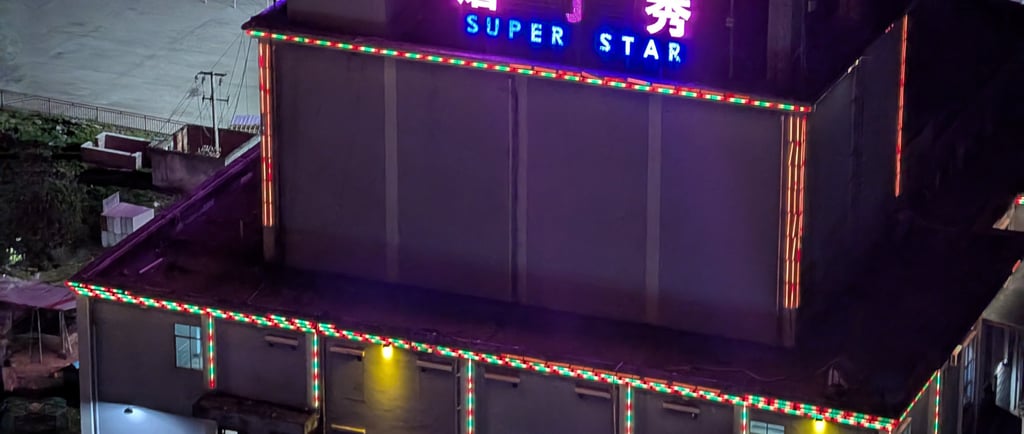
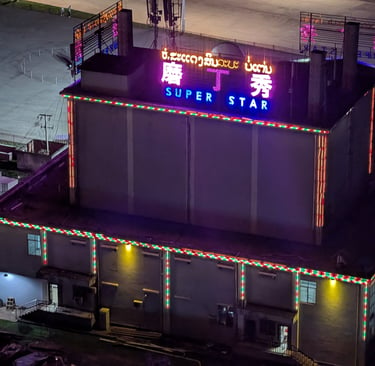
After two months of cycling through China, we crossed the border into Laos without really knowing what to expect. On the other side, Boten greeted us with a heavy, unsettling atmosphere, as if time itself had stalled in that blurred strip between two countries. It was our first stop in Southeast Asia and, rather than excitement, we felt exhaustion. We decided to stay for two nights to rest, clear our heads, and figure out our next route.
That first evening, we went out for dinner at the market—a kind of food court lit by harsh white lights, filled with the clatter of pots and dishes wrapped in plastic bags. We quickly noticed that the signs and menus were all in Chinese; you could even pay in yuan using the same apps we had used in China. We didn’t think much of it at the time. In border towns, currencies and languages often blend naturally, bringing people from both sides together.
As we walked through the city center, something felt off. There were modern buildings and several more under construction, plenty of accommodation options, and a certain level of activity in the streets—but we couldn’t quite understand why. Why so many hotels? So many services? Clearly, there was nothing here that would normally attract tourists. We guessed there might be something nearby, but there really wasn’t. Maybe it was just a transit hub where people stopped briefly before moving on. Who were all these people, and why were they here? We observed in silence and eventually returned to our hotel with a feeling we still couldn’t quite name.
On the second night, we went out again. We had dinner at a small restaurant and then walked toward the larger market we hadn’t yet explored. After passing the fruit and vegetable stalls and a few scattered eateries, the lighting suddenly changed—and everything turned pink.
Where there had been ordinary shops before, there were now raised platforms with chairs facing the street. Sitting on them were groups of teenage girls, heavily made up, with bright red lipstick and high heels. Some were barely of legal age; others likely not even that. They chatted among themselves, looked at their phones, and waited as if sitting in a bank queue. We kept walking in silence, almost on autopilot. It wasn’t just one stall—it was many, and each one was filled with girls. Around them, groups of men walked alone through the same space. That night, with a knot in our stomachs and a growing sense of helplessness, we finally began to understand how Boten worked.
As soon as I got back to the hotel, I dove into the internet. There had to be something written about this—I needed to understand what we had just seen. The more I read, the more the same words kept appearing: casinos, prostitution, drugs. Every page made things darker, and with each click it became clear that this wasn’t just about one city, but a wider pattern across Southeast Asia.
I learned that this place—so close to China and Myanmar—lies in a Special Economic Zone within the so-called Golden Triangle. Boten, in particular, had once been a casino town, largely frequented by Chinese visitors, since gambling is illegal in China. Where there are casinos in places like this, there is often also drug trafficking and prostitution, and likely much more operating beneath the surface in service of money.
A few years ago, the Chinese government pressured Laos to shut down the casinos and crack down on the more illicit side of the city. Many Chinese had been drawn here by looser regulations and fewer restrictions than at home.
Today, the city is different, but the traces of that period are still visible. From the outside, there are new buildings and clean streets, but it only takes a turn into a side alley in the market for the pink lights to remind you that, for many, reality has not changed at all.
mauge@deaculla.es
Newsletter
Revista Cicloviaje
Join us
deacullá
Políticas de Privacidad
Términos y Condiciones